:
September 17, 2026
One engineer, shipping one change, can move your gross margin overnight. Your books won't notice for thirty days. Tokenomics is an accounting problem, and T:0 is built for it.
One engineer, shipping one change, can move your gross margin overnight. Your books won't notice for thirty days. Tokenomics is an accounting problem, and T:0 is built for it.
Anthropic walked into its IPO asking investors to judge it by a number nobody had seen before: gross margin, measured before the cost of training the models. The internet did what the internet does. WeWork jokes. Screenshots. Adjusted-EBITDA memes from people who lived through 2019.
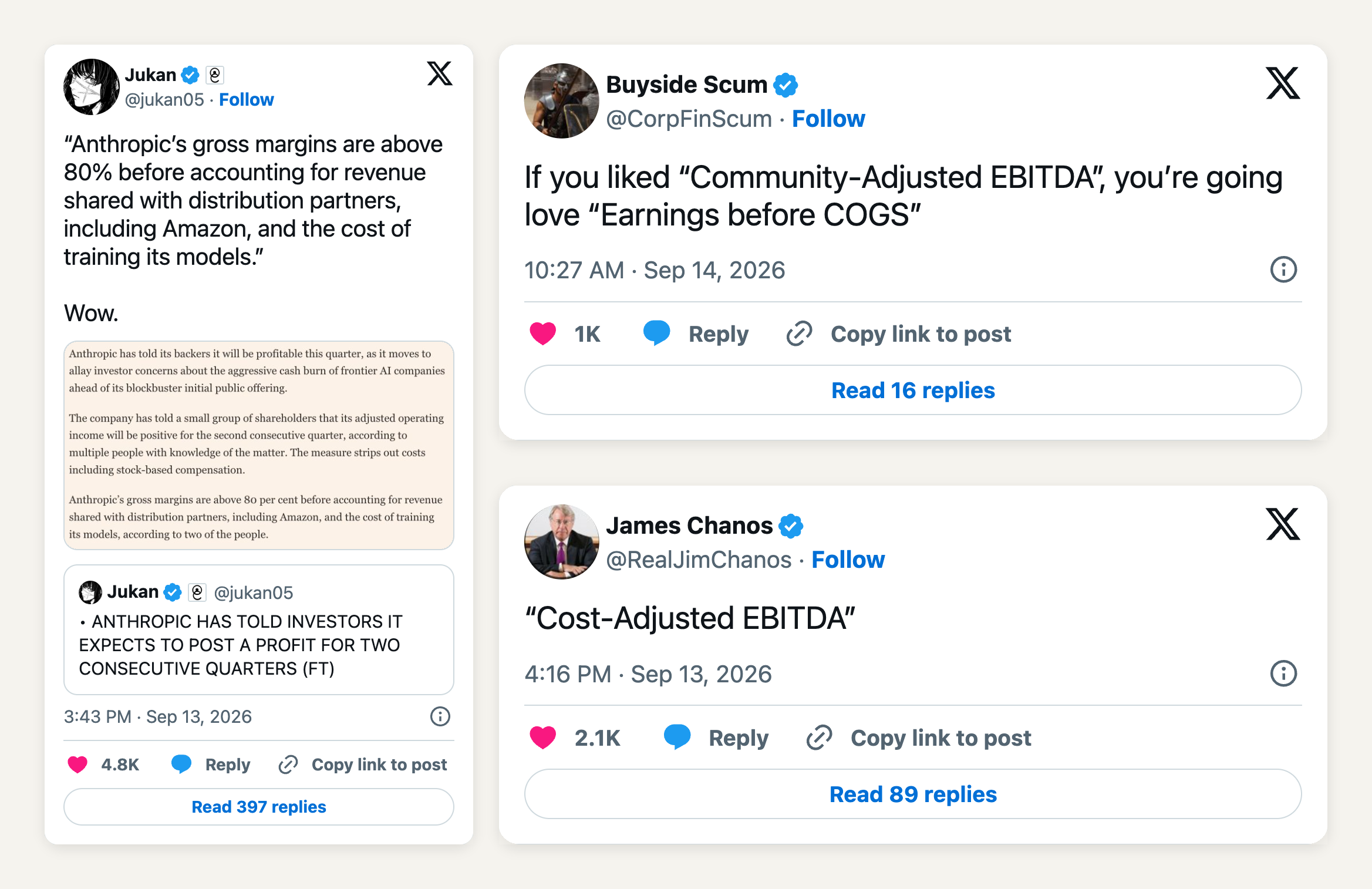
The jokes miss the interesting part. The biggest AI company on earth just admitted, in public, with auditors watching, that AI costs fit the existing accounting categories so poorly it had to invent a new one. For Anthropic, the cost that didn't fit was model training. If you buy AI rather than sell it, you have the same problem in mirror image. Your awkward cost isn't training, it's usage: the per-request fee you pay OpenAI or Anthropic every time your product calls a model on behalf of a customer. That fee is a direct cost of revenue, no different from hosting. But at most companies it never gets treated that way. The bill lands on the company card and gets filed under software subscriptions, next to Slack and Notion. Your gross margin looks great, but it's answering the wrong question. What does it actually cost to run your product?
Anthropic's number hit a nerve because every AI business is being asked that same question right now. The answer is supposed to be gross margin. But the argument over how to measure it has sides, stakes, and a fresh hot take every week, and investors aren't the only ones who care. Inside every company shipping AI features, an engineering leader and a finance leader are having the same fight: one holding a usage dashboard, the other holding an invoice, neither holding a number they both believe.
Everyone has an opinion on AI margins. Almost nobody has measured one, because almost nobody's books can produce the number properly.
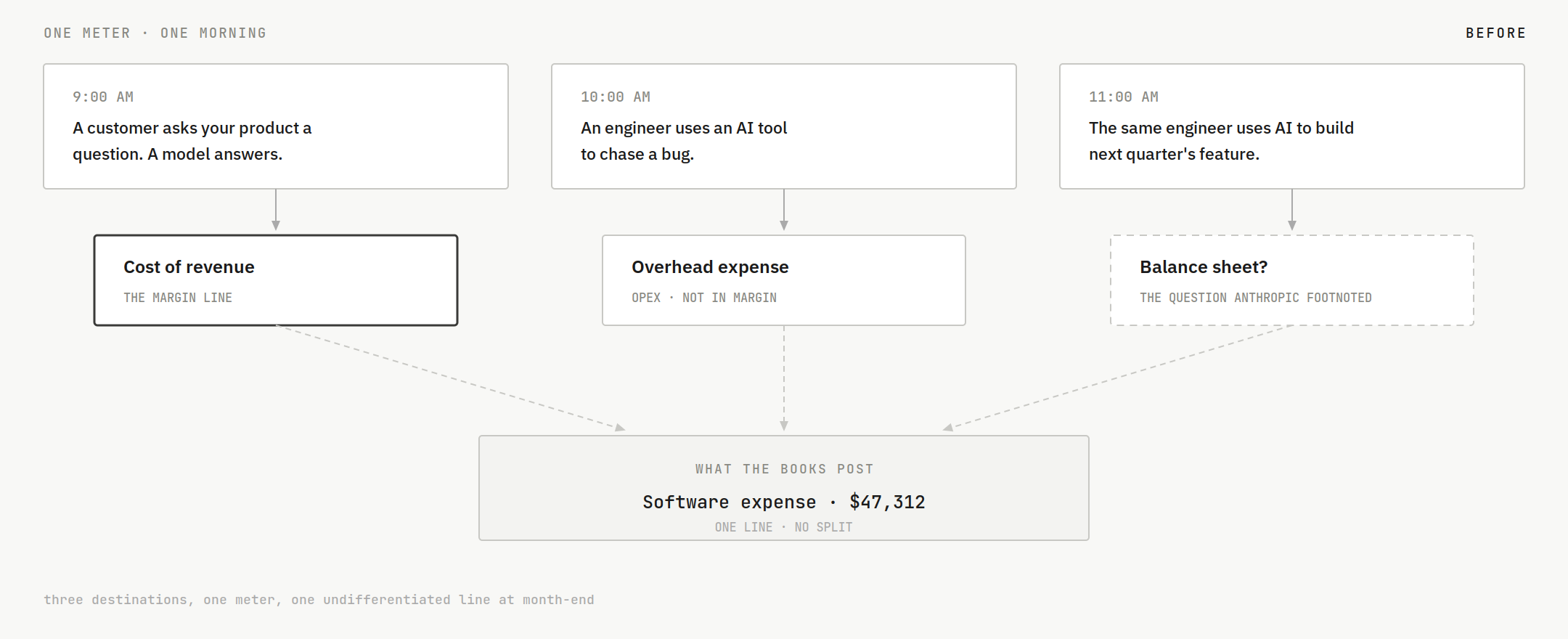
We can show you exactly why: there's an invoice sitting in a CFO's inbox this morning. One line: $47,312, model usage, billing period July 25 through August 24. It will be approved by Friday, coded to software expense, and forgotten. It's the third largest cost in the company, and it's the only large cost nobody can explain.
Now watch what happens when someone asks a question about that expense. A board member asks “how much of it was the cost of serving customers?”, because that's the margin number, and the answer is a shrug: “we can't split the expense.” The auditor asks “what part belongs to August?”, since the billing period ran July 25 to August 24, and the answer is “all of it,” which is wrong. An engineer who wants to shrink the bill asks “which team and which feature are burning it?” Shrug. One line, three questions, zero answers.
The maddening part is that your provider has the data to answer every one of those questions. The provider meters every token by the day, the model, and the team that burned it. The reading just stops at the invoice. It never reaches the books.
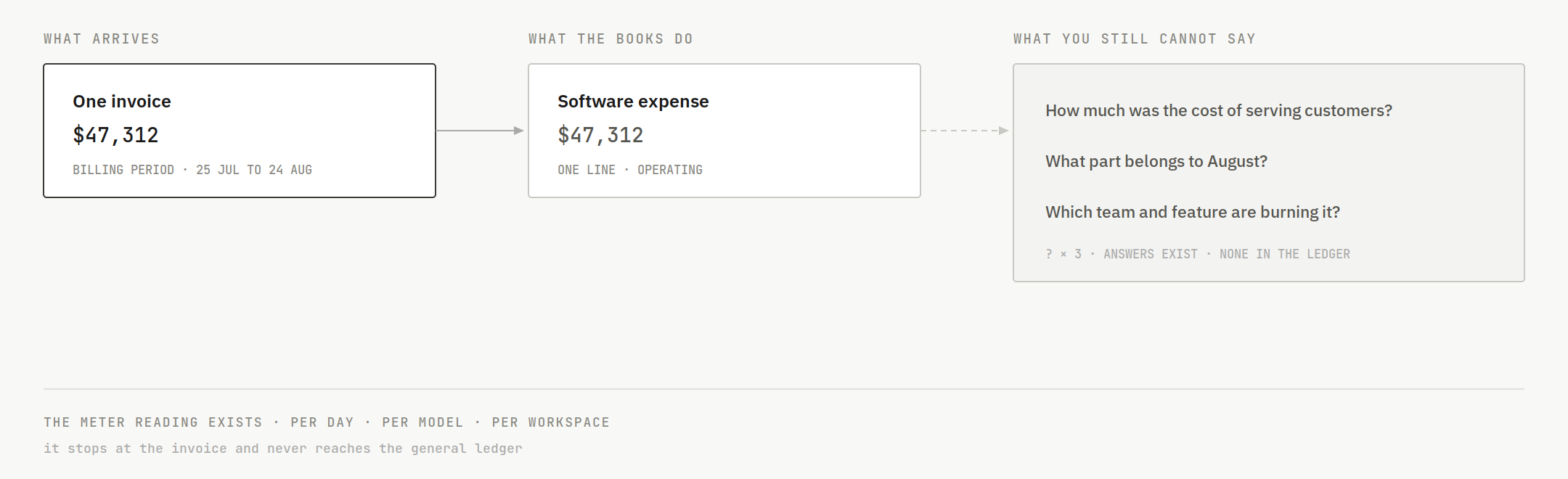
The board member's question is the one the whole fight turns on. Gross margin comes down to how much of that $47,312 went to serving customers. The split exists, day by day, in the meter reading, and the books never got it. So a company whose product calls models all day, with the whole bill parked in operating expense, overstates its gross margin every quarter. Nobody committed fraud. The books just filed a cost of goods item under software subscriptions.
Which means the margin discourse is a fight about a number neither side has computed. The sellers improvise metrics in public, where at least the jokes keep them honest. The buyers improvise inside their own ledgers, where there is no audience to catch it.
Your margin isn't bad. It's just unmeasured. And unmeasured turns into “bad” at the worst possible moments: in an audit, in diligence, or in the board meeting.
Which raises an obvious question: if the reading exists and the stakes are this high, why hasn't anyone simply fixed the books? The answer is that this cost breaks rules the chart of accounts has relied on for a century.
To fix the problem, you need to start with what's inside the meter.
That last question, scaled to billions, is the same one Anthropic just wrapped a footnote around: is money spent building the machine an expense or an investment? Three destinations in the books, one meter, one undifferentiated line at month-end. A power meter never raised this problem, because electricity was always overhead and no one needed to ask which kilowatts were the cost of goods. With tokens, that same question decides the margin everyone is fighting over.
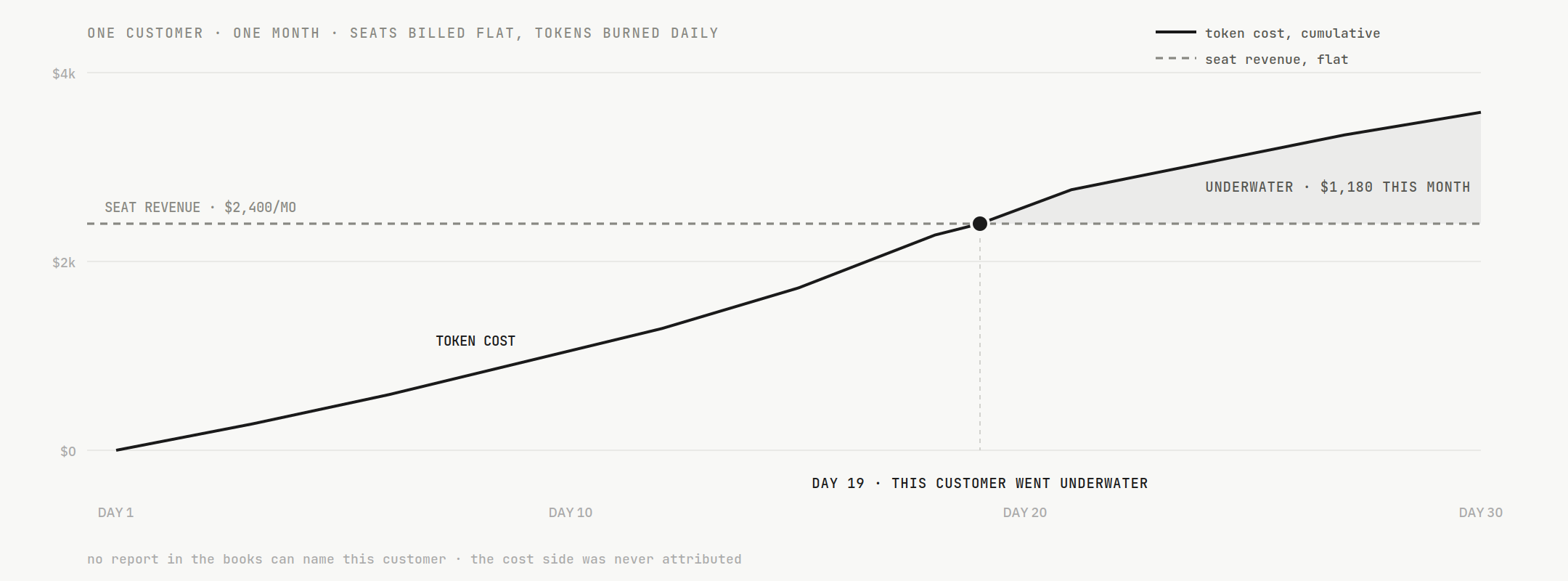
Then there's what tokens did to software economics. For twenty years software's superpower was zero marginal cost: serving one more customer cost nothing, and 80-point gross margins were built on that fact. Tokens ended that. Every customer request now burns real money, while most pricing is still flat. Which means something that was impossible in SaaS is now routine and invisible: the individually unprofitable customer. You can be losing money on your heaviest user this month, and no report in your books can name them, because the cost side was never attributed.
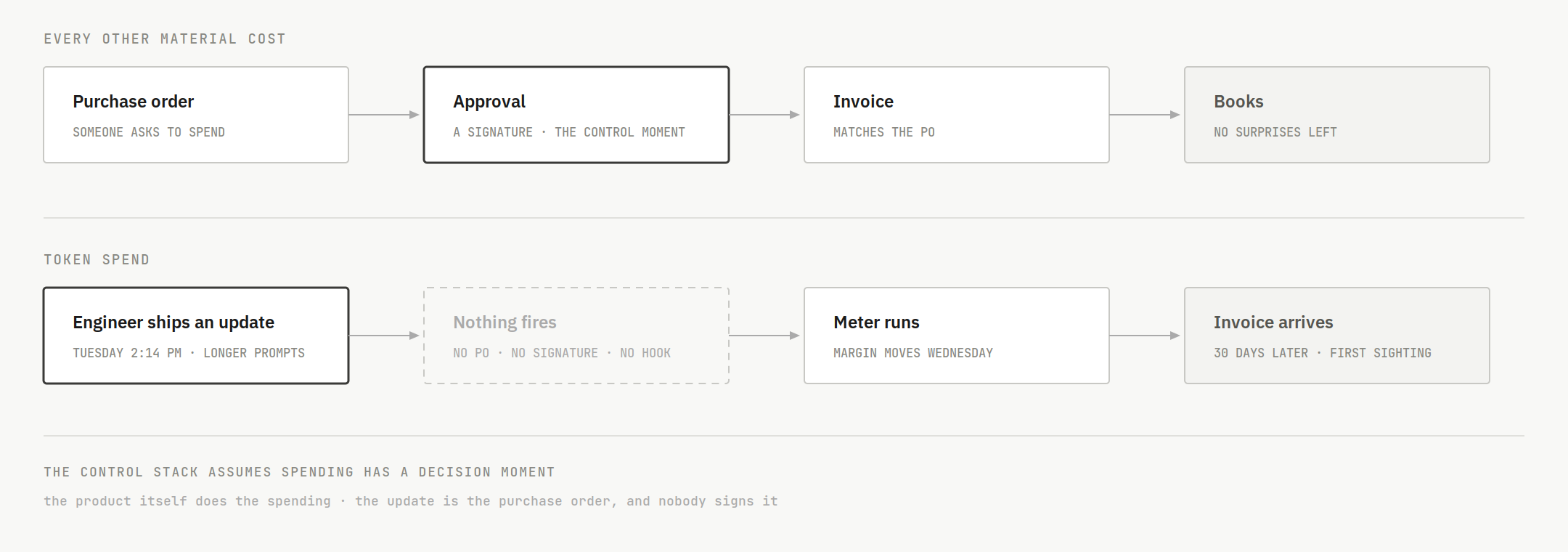
And strangest of all, this cost has no approval moment. Every other material expense gets a “yes” from somebody before it happens: a purchase order, a contract, a signature. That's where a company's spending controls live. Token spend skips all of it, because the product itself does the spending. An engineer ships an update on Tuesday, one that asks the model longer questions, or switches to a more powerful model, and the spending starts the moment customers touch it. By Wednesday, gross margin has been compressed and no one ever signed off.
There's one tempting way out of all this: token prices keep falling, so maybe the bill shrinks until none of it matters. It won't. In 1865, an English economist named William Stanley Jevons noticed something strange about coal: steam engines kept getting more efficient, and coal use rose anyway, because cheap steam found its way into everything. Economists still call it the Jevons paradox, and Satya Nadella pointed straight at it the week a cheap Chinese model panicked the market. Token prices will keep falling, and your bill will keep growing, because cheap tokens end up inside everything.
So the bill is permanent, the books are blind, and the fix sits in nobody's job description. Engineering has the data. Finance has the ledger. Someone has to connect them.
The industry has a name for managing all this: tokenomics. Right now tokenomics lives in engineering, as dashboards, cache hit rates, cost per call. The dashboards are good. They're also unpostable. A dashboard can tell an engineer where tokens went; it cannot move a dollar into cost of revenue, carry an accrual, or survive an audit. Tokenomics done for real is an accounting motion that starts from engineering's data, and until now it has fallen in the gap between those two jobs.
T:0 is built on these two ideas. Books should be derived from events rather than written after the fact. And every number should sit on a connected map, linked to whatever proves it. Token spend slots straight into both. Each usage record links to the invoice that bills it, day by day, which turns invoice reconciliation into confirmation. And each record already says what the spend was for: the product serving customers, a team's tools, an internal experiment. The split derives into journal entries mapped to your chart of accounts.
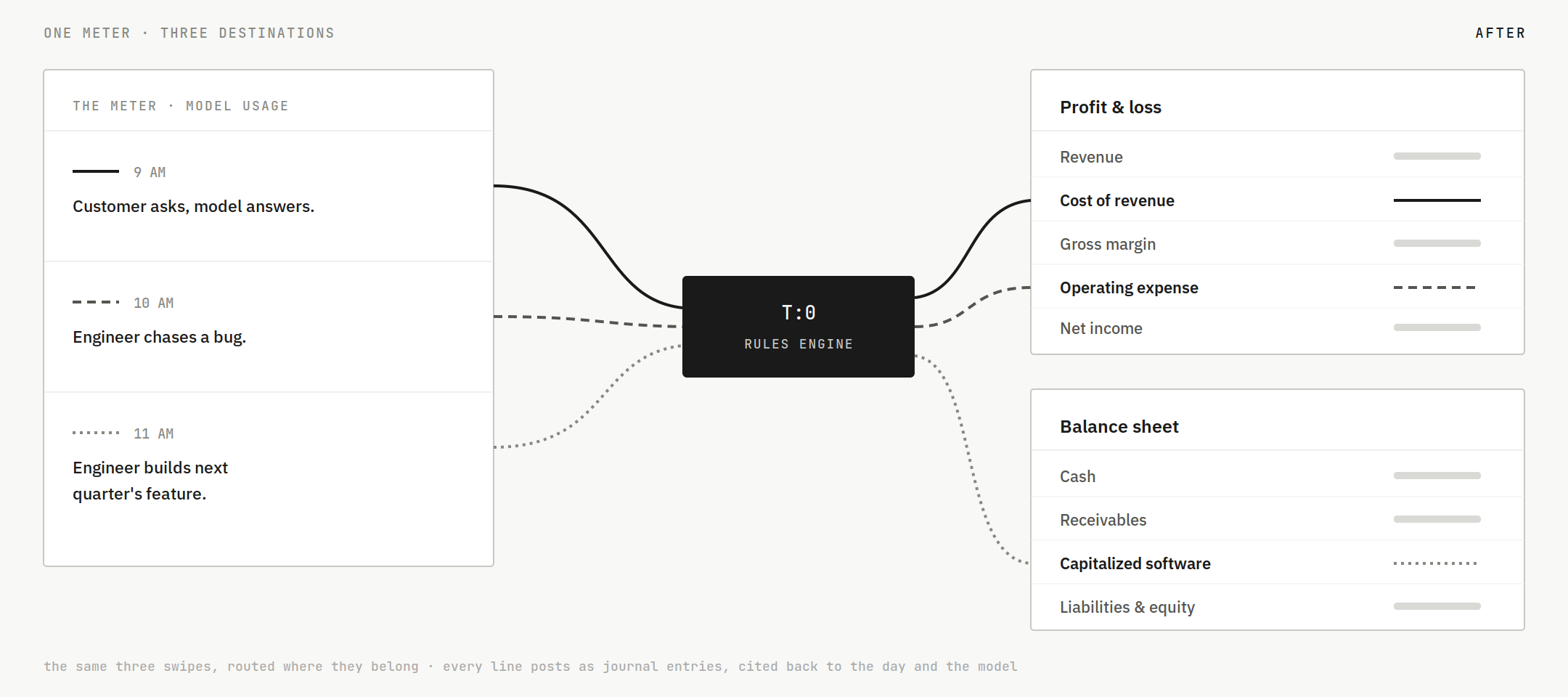
Run the motion on our August invoice from the earlier example and here's what comes back. Of the $47,312:
Net effect on gross margin: 7.6 percentage points. None of it is new spending. All of it was in the wrong account.
A few weeks after the restatement, the CFO types a question into T:0: which customers cost more to serve than they pay us? The answer comes back in seconds with three names on it. The biggest is a logo sale celebrated in March: $2,400 a month in seats, $3,580 a month in tokens, underwater since the 19th. Remember, this customer was invisible an hour ago. Now they are three separate journal entries and a renewal conversation.
Every answer arrives like that, with its entries cited, each figure traceable to a day and a model. That matters more than speed. It also settles the standoff from the opening. The engineering leader's dashboard and the finance leader's invoice stop competing, because both are now downstream of the same entries. Engineering gets spend ranked by model, workspace, and product, so the optimization conversation opens on a number instead of a hunch. Finance gets attribution it can post, accrue, and defend. Ship the caching change on Tuesday, watch cost of revenue move by Friday, in the books.
Every finance system in existence was built for invoices: discrete documents, known amounts, vendor calendars that match yours. AI spend arrives as a meter, and it isn't even the first. Cloud compute has been a meter for fifteen years, and most books never caught up with it either; the difference is that AI walked straight into the middle of gross margin, where there could be legal implications for not “catching up.” Consumption pricing is eating software while software eats everything else, and the companies that learn to account for meters now are building muscle the next decade keeps rewarding.
Jevons was right about coal and he's right about tokens: efficiency won't shrink this line, it will multiply it. The bill grows either way. What are you doing to be able to say what it bought?
The invoice tells you what you paid. T:0 built the part that tells you what you paid for.